
Richmond wants to charge utilities for digging up its busiest roads at the busiest times, with charging from May 2027. Councillors vote on it on Monday.
Richmond Council wants to start charging utility companies for occupying its busiest roads at the busiest times, and councillors take the first decision on Monday.
The proposal is a lane rental scheme. It is set out in a report to the council’s Transport and Air Quality Committee on Monday 7 September, from Paul Chadwick, Executive Director of Resident Services. The committee is asked to approve continued development of the scheme, to start statutory and stakeholder consultation, and to note the timetable.
That timetable puts the scheme’s start in April 2027, with charging beginning in May 2027.
What lane rental actually does
Richmond already runs a permit scheme for street works. The report is direct about its limits. A permit scheme coordinates works, but it gives a contractor no financial reason to avoid the worst road at the worst hour.
Lane rental adds that reason. Councils can charge works promoters for occupying designated traffic-sensitive roads during defined charging periods. The intended effect is not the money. It is that works get scheduled at night, at weekends, or off the worst routes altogether.
Transport for London has charged on its own network since 2012, and the Department for Transport, TfL and London Councils have since built a pan-London framework for boroughs to follow. The report names Lambeth, Merton, Camden and Enfield as London boroughs that have already brought schemes in.
One detail matters for anyone who assumes this is a tax on outside contractors only. The report says the scheme would apply equally to utility companies, contractors and highway authority works. The council would be charging its own road works too.
The timetable
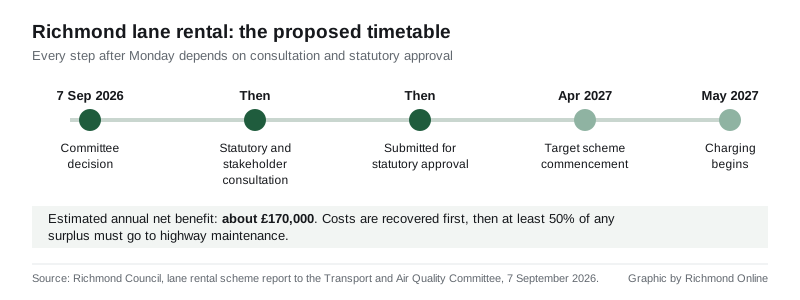
If Monday goes the officers’ way, the council consults utility companies, contractors, Transport for London and neighbouring authorities. Responses are used to refine the scheme, which then goes through a statutory approval process before it can charge anyone.
Where the money goes
Lane rental income cannot be spent freely, and the report sets out the rules.
- operating and administration costs are recovered first
- at least 50% of any surplus must go to highway maintenance
- the rest can only fund approved initiatives that reduce disruption or support innovation in street works
The council’s own financial modelling, from a Richmond and Wandsworth lane rental business case produced this year, puts the estimated annual net benefit at about £170,000 after operating costs and income offsets.
That is a modest figure for a borough of Richmond’s size, and it is the point. The report argues the case on disruption rather than revenue, listing reduced congestion, more reliable journeys, better coordination of works and improved air quality from fewer delays.
Any extra staff needed to run the scheme would be paid for out of scheme income, and the report states this will not create an unfunded pressure on existing council budgets.
What we could not confirm
The report does not name a single road. It refers throughout to “designated traffic-sensitive routes”, and says defining that network is part of the project work still to be done. So there is no way to tell yet whether the road outside your house is in or out.
It is also worth noting how the paper is classified. The report’s own front sheet marks it “KEY DECISION? NO”, despite proposing a new charging regime across part of the borough’s road network.
Officers do set out the risks they see: delays in getting statutory approvals, not enough resource to run the scheme, objections during consultation, income coming in under forecast, and uncertainty about future governance and how any surplus is allocated.
What it means for you
Nothing changes on the road on Monday, and nothing changes for a household bill.
Lane rental is charged to the company doing the digging, not to residents or to drivers. There is no new charge for using a road, no permit for residents, and no change to parking.
What could change, from May 2027 at the earliest, is when works appear on the busiest routes. If the scheme works as intended in the boroughs that already have one, more of the disruptive jobs move to evenings, nights and weekends, and fewer of them sit on a main road through the morning peak.
Two things are worth doing now if you have a view:
- the consultation is aimed at utilities, contractors, TfL and neighbouring councils, so residents are not the target audience for it. The route for a resident’s view is the committee itself.
- Monday’s meeting is at 7pm at York House and is webcast. The full reports pack is published in advance.
For the closures and restrictions running right now, our Richmond roadworks and travel page is checked against the council’s own traffic orders each week. The same committee decides on Monday whether to consult on school streets at eight more schools.
Sources
- Progress a Lane Rental Scheme for the London Borough of Richmond upon Thames, report to committee, 7 September 2026
- Transport and Air Quality Committee agenda, 7 September 2026, London Borough of Richmond upon Thames
- Street Works (Charges for Occupation of the Highway) (England) Regulations 2012, the regulations the scheme would be made under
- New Roads and Street Works Act 1991, the parent legislation
Have your say