
Band D is £2,486.10 this year, up 4.81%, with the council's own share fourth highest in London. Every band from A to H, and the Barnes and Putney gap.
A band D home in Richmond upon Thames pays £2,486.10 in council tax in 2026/27. The council takes £1,975.59 of that and the Greater London Authority takes £510.51.
There are no parish councils in the borough, so that is the whole bill. It is up £114.03 on last year, or £2.19 a week, a rise of 4.81%.
The full band A to H table for 2026/27
| Band | Property value in April 1991 | Richmond Council | GLA precept | Total 2026/27 |
|---|---|---|---|---|
| A | Up to £40,000 | £1,317.06 | £340.34 | £1,657.40 |
| B | £40,001 to £52,000 | £1,536.57 | £397.06 | £1,933.63 |
| C | £52,001 to £68,000 | £1,756.08 | £453.79 | £2,209.87 |
| D | £68,001 to £88,000 | £1,975.59 | £510.51 | £2,486.10 |
| E | £88,001 to £120,000 | £2,414.61 | £623.96 | £3,038.57 |
| F | £120,001 to £160,000 | £2,853.63 | £737.40 | £3,591.03 |
| G | £160,001 to £320,000 | £3,292.64 | £850.85 | £4,143.49 |
| H | Over £320,000 | £3,951.17 | £1,021.02 | £4,972.19 |
Source: the council’s bands and charges page and its Guide to Council Tax and Business Rates 2026/27. The Richmond column already includes the adult social care precept, which government has required councils to show as one merged figure. Band values are what a property would have sold for on 1 April 1991, not what it is worth now.
Bills are normally spread over 10 instalments, so band D is £248.61 a month. You can ask for 12 instead, which brings band D down to £207.18 a month without changing the annual total.
What changed this year
| Band D | 2025/26 | 2026/27 | Change | % |
|---|---|---|---|---|
| Richmond Council | £1,881.69 | £1,975.59 | +£93.90 | 4.99% |
| Greater London Authority | £490.38 | £510.51 | +£20.13 | 4.10% |
| Total | £2,372.07 | £2,486.10 | +£114.03 | 4.81% |
Richmond’s 4.99% is the maximum it could charge without holding a referendum: 2.99% for core services plus 2% ringfenced for adult social care. The council took the whole of both.
The GLA’s £20.13 goes almost entirely to policing and the fire brigade. Neither the Transport for London share nor the City Hall share moved at all:
| GLA element, band D | 2025/26 | 2026/27 | Change |
|---|---|---|---|
| Metropolitan Police (MOPAC) | £319.13 | £334.13 | +£15.00 |
| London Fire Brigade | £71.72 | £76.85 | +£5.13 |
| Transport for London | £77.09 | £77.09 | nil |
| Greater London Authority | £22.44 | £22.44 | nil |
Where Richmond sits in London
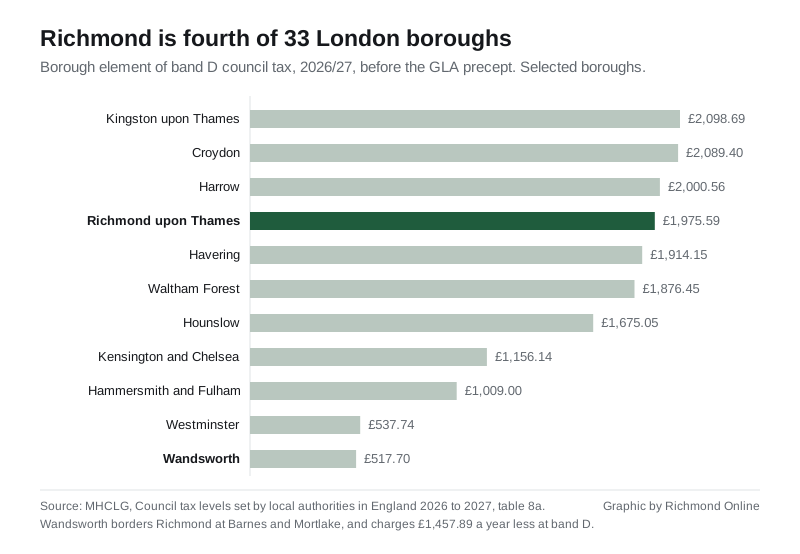
The government publishes the borough element of band D council tax for every authority in England each spring. In the 2026 to 2027 release, table 8a puts Richmond fourth of the 33 London authorities, behind Kingston upon Thames (£2,098.69), Croydon (£2,089.40) and Harrow (£2,000.56).
Behind those four come Havering at £1,914.15, Waltham Forest at £1,876.45 and, closest to Richmond geographically, Hounslow at £1,675.05. The cheapest London boroughs are all in the inner west: Kensington and Chelsea at £1,156.14, Hammersmith and Fulham at £1,009.00, Westminster at £537.74 and Wandsworth at £517.70.
Table 7 in the same release gives the average band D bill across London as £2,068.47, including the GLA precept. Richmond’s £2,486.10 is £417.63 above that. The England average is £2,391.52.
The Barnes and Putney gap
The borough boundary at Barnes and Mortlake is one of the sharpest council tax cliff edges in the country. Cross it into Wandsworth and the borough element drops from £1,975.59 to £517.70.
That is a difference of £1,457.89 a year at band D for two houses that can be a few hundred yards apart. Wandsworth put its share up by 2.04% this year; Richmond put its up by 4.99%. Both figures are from table 8a, and both boroughs pay the same £510.51 GLA precept on top.
What the money pays for
Richmond’s net service budget is funded 80% from council tax, 18% from the Revenue Support Grant and other non-ringfenced grants, and 2% from retained business rates. Its own guide breaks gross spending down as:
- Adults and housing, 40%
- Children’s services, 22%
- Environment and community services, 19%
- Corporate functions including finance and transformation, 14%
- Central costs, 5%
The 2026/27 budget puts the council tax requirement excluding the GLA at £178.502m, spread over a tax base of 90,354 band D equivalent properties. Four levies come out of it before that: the West London Waste levy at £9.588m, Lee Valley Regional Park at £238,000, the Environment Agency flood defence levy at £218,000 and the London Pensions Authority at £28,000.
The blunt number in the budget is the Revenue Support Grant. It rises from £244,000 in 2025/26 to £38.499m in 2026/27, while retained business rates fall from £30.528m to £1.514m. The council describes the settlement as a “once-in-a-generation reset” that still leaves it with a significant real-terms reduction over three years, and says it will deliver a further £11m of efficiencies in 2026/27, on top of £105m since 2011/12.
How to check and challenge your band
Bands are set by the Valuation Office Agency, not the council. Check yours with the VOA band search, and challenge it through GOV.UK if you think it is wrong. You must keep paying at the current band while an appeal is decided.
The council flags on its own bands page that the VOA is running late on new developments, banding changes and property splits and merges, and that it cannot chase an assessment on your behalf. Contact the VOA directly.
Discounts and reductions
None of these are applied automatically. You have to claim.
- Single person discount: 25%, if you are the only adult in the property.
- Full-time students can be exempt entirely, or discount a mixed household. Student nurses and most apprentices earning no more than £195 a week are disregarded too.
- Disabled band reduction: if a property has been significantly altered for a disabled resident, the bill drops to the next band down.
- Severe mental impairment: the person is disregarded, on evidence of a qualifying benefit. The council writes to their doctor to confirm.
- Carers providing 35 hours a week on average are disregarded, but not if they are caring for a spouse, partner or a child under 18.
- School and college leavers under 20 are disregarded from the end of their course until 1 November the same year.
- Annexes and job-tied accommodation: 50% off.
The full list is on the council’s discounts page. Be aware that some of the links on it still point at Wandsworth’s website and Wandsworth’s forms, left over from the two boroughs’ shared staffing arrangement. Apply through Richmond’s own form.
Council Tax Reduction
Pensioners get up to 100% of their liability covered under the government’s prescribed scheme. Working-age households go into one of five local bands:
- Scheme 1, no earned income and receiving a disability or carer’s benefit: 100%, and it is the only band not capped
- Schemes 2 and 3, on Income Support, income-based JSA, income-related ESA or Universal Credit and not in work: 100%, capped at the band E charge
- Scheme 4, no dependent children, in work: 80% at up to £125 net a week, then 65%, 50% and 35% as earnings rise to £475
- Scheme 5, with dependent children, in work: 85% at up to £125 net a week, then 70%, 60% and 40% to £475
The band E cap is the detail that costs money. If your home is band F, G or H, the most you can get under schemes 2 to 5 is the band E amount, £3,038.57, and you pay the difference yourself. Working-age applicants must also have under £16,000 in savings. Details and the scheme rules are on the council’s eligibility page.
Households moved into schemes 4 and 5 who lost support under the 2025/26 changes were given transitional protection, paid straight onto their council tax account. It tapers: full support in year one, two thirds in year two, one third in year three, then nothing.
Second homes and empty homes
Richmond charges a 100% premium on second homes, meaning double the standard bill, from the day a substantially furnished property stops being someone’s main residence.
Long-term empty and unfurnished homes are charged on a rising scale:
| Empty for | Premium | You pay | Band D bill |
|---|---|---|---|
| 1 to 5 years | 100% | 200% of the standard bill | £4,972.20 |
| 5 to 10 years | 200% | 300% | £7,458.30 |
| Over 10 years | 300% | 400% | £9,944.40 |
The band D column is the standard £2,486.10 multiplied out. The premium follows the property, not the owner: it still applies if the house changes hands.
Statutory exceptions exist for probate, active marketing for sale or let, annexes, armed forces accommodation and major structural repairs, most of them lasting 12 months. Job-related dwellings, occupied caravan pitches and boat moorings, and homes with a planning restriction preventing year-round occupation are excepted from the second home premium only. Both premium pages set out the conditions in full: empty property, second home.
One warning if you are reading the council’s second home page. Its worked example says “if your standard bill for the year is £1,581.38, you will pay £3,162.76”. £1,581.38 is not a Richmond charge at any band in 2026/27. The arithmetic is right, the figure is stale. Use the table at the top of this page.
Also on Richmond Online
- Richmond bin collection days, and what the waste levy costs
- Parking in Richmond, tariffs and permits
- Roadworks and travel
Every figure here was checked against the council’s own pages and the government’s published tables on 30 August 2026. Charges are set each February and apply from 1 April.
Have your say