
Richmond Council says its £52m reserves could fall to £28m this year and run out within four years. It sent its challenge to ministers on 22 October.
Richmond Council says its financial reserves could run out within four years. It blames changes to how the government funds councils.
Updated 23 October: the consultation has closed and the council formally sent its proposal to the government on 22 October. More than 2,200 residents took part. The detail is in the section on the consultation below.
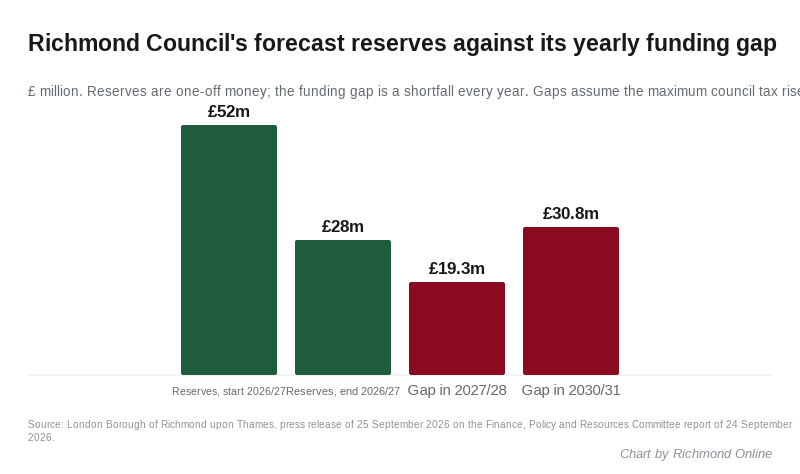
The warning comes from a report to the council’s Finance, Policy and Resources Committee on 24 September. The council set out the main figures in a press release the next day:
- Reserves were £52 million at the start of 2026/27.
- They could fall to £28 million by the end of this financial year.
- Even with the largest council tax rise the government allows, the council expects a funding gap of £19.3 million in 2027/28.
- That gap rises to £30.8 million by 2030/31.
Put those side by side and the problem is plain. The £28 million the council expects to have left in March would not cover the single-year gap it forecasts for 2030/31.
Why the council says this is happening
The council says government reforms will cut its annual core funding by £29 million by 2028/29. It puts that at around 58% of its core funding allocation, and says it is the largest percentage cut in London.
The council’s consultation page adds that the cut is being phased in over three years. It says that is shorter than in previous funding reviews, and contrasts it with the eight years given to areas in local government reorganisation to line up their council tax.
These are the council’s own figures and its own framing. The government’s reasons for the changes are not set out in the release, and we could not open the committee report itself on 29 September because the council’s committee website was returning errors.
Councillor Gareth Roberts, the council leader, said: “Reserves are there to manage risk and give councils breathing space, not to plug permanent gaps created by grossly unfair national funding decisions.”
What the council is doing about it
The council says it is:
- reviewing its spending
- fast-tracking £39 million of savings
- changing how services are delivered through what it calls a transformation programme
A separate paper at the same meeting reviewed the council’s building and investment plans. The revised six-year capital programme is £233.9 million, with a potential borrowing requirement of £124.7 million. Schemes already approved will be reviewed over the coming months, and projects that save money every year will get priority.
The council has not said which services or schemes could be affected.
The consultation, and the council’s submission
The council submitted its proposal to the government on 22 October, its press release that day says. Wandsworth, Westminster and Kensington and Chelsea have made the same kind of submission. The council says:
- more than 2,200 residents took part in the consultation
- over 95% supported action under the Sustainable Communities Act
- more than 92% strongly supported it
The consultation was open to anyone who chose to respond, so those figures show the views of the people who took part rather than of the borough as a whole. The release puts the cut at £29 million a year by 2028/29, around 58% of the council’s core funding, and £102 million over four years.
What the consultation asked:
The council wants to send the government a formal proposal under the Sustainable Communities Act. That law lets councils ask ministers to remove laws or policies that hold back their area. A council can only submit one if it has consulted residents and they support it.
The consultation opened on 16 September and closed on 14 October 2026. It asks whether you support the proposal, and what it should prioritise. The council suggests three changes:
- a rethink of the proposed funding allocations
- a longer transition period, in line with previous funding reviews
- a greater share of locally raised income kept by councils
What it means for you
Nothing changes to your bill or your services today. But the council’s own forecasts point to a hard choice within a few years, between deeper cuts, higher charges and drawing reserves down to nothing. Its gap forecasts already assume the largest council tax rise the government allows. What you pay in each band now is on our Richmond council tax bands page.
The consultation has closed and the case is now with ministers. The next point where the figures change is the government’s provisional finance settlement, and then the council’s own budget for 2027/28.
Sources
- Richmond warns reserves could run out as government funding cuts deepen financial pressure, London Borough of Richmond upon Thames, 25 September 2026, reporting the Finance, Policy and Resources Committee meeting of 24 September 2026.
- Sustainable Communities Act consultation, London Borough of Richmond upon Thames, open 16 September to 14 October 2026, read 29 September and 23 October 2026.
- Richmond takes fight against ‘reckless’ £102m funding cut to Whitehall, London Borough of Richmond upon Thames, 22 October 2026.
Have your say