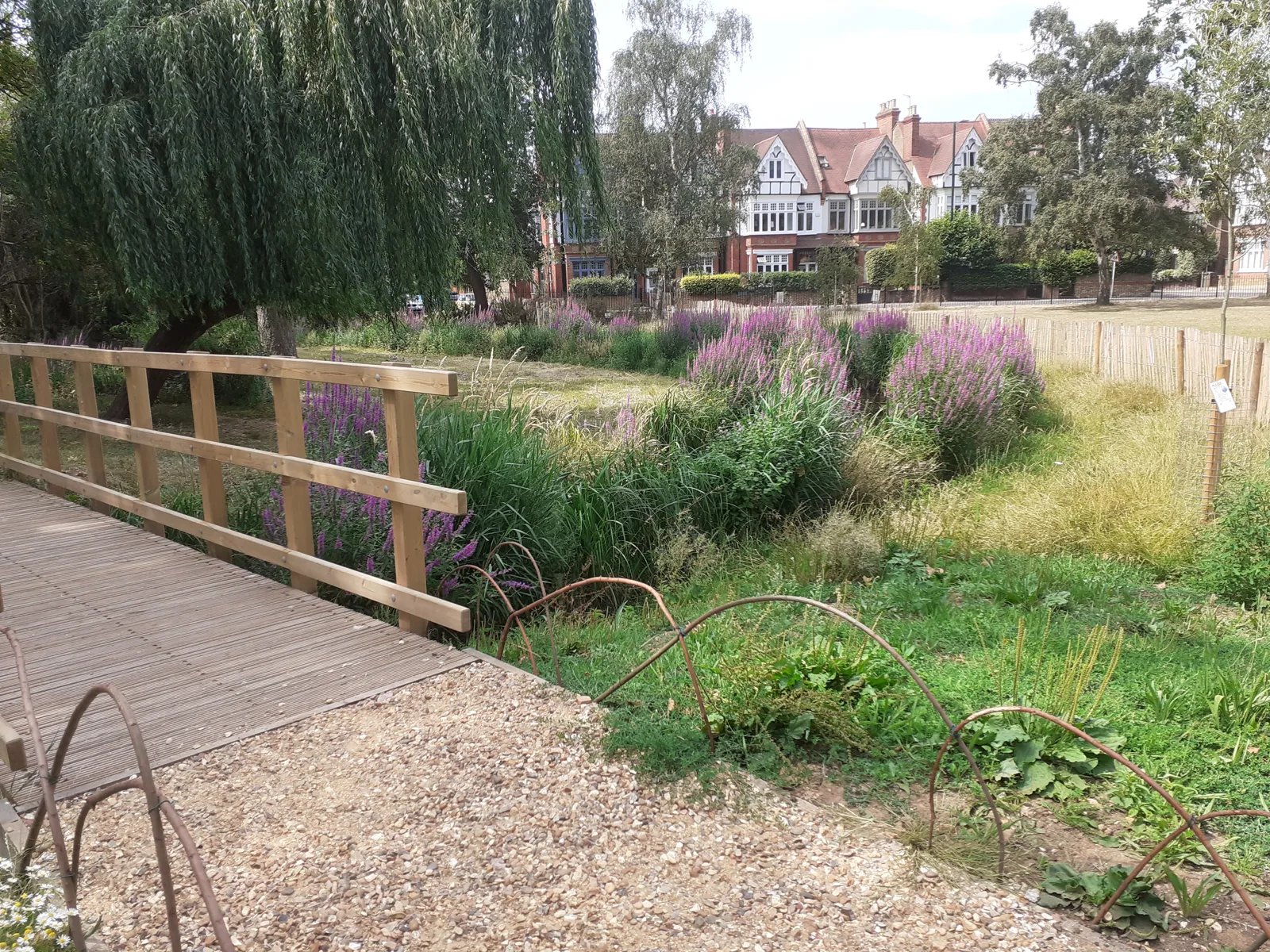

The Beverley Brook now winds round a new island on Barnes Green, reached by an accessible footbridge, with a dog paddling area and seven new trees.
The river restoration on Barnes Green is finished. The Beverley Brook now takes a winding course through the Green, round a small new island, and the island is open to everyone by a new accessible footbridge.
Richmond Council announced the completion on 1 October. The project team’s own project page says the work “has now been successfully completed”.
What has changed on the Green
The project page lists what has been built:
- a new channel. The brook has been redirected through the Green on a winding line that the team says better reflects its historic course. The new channel creates the island.
- the old channel kept. The original channel stays in place to give flood water somewhere to go.
- swales. Shallow channels reconnect the brook with its floodplain, to hold water in heavy rain.
- an accessible footbridge from the Green to the island.
- a dog paddling area, with stepped access, so dogs can get into the water without wearing away the banks.
- reinforced banks, built from natural materials.
- seven new trees, plus native wildflowers and other planting.
Some of the planting is still behind temporary fencing. The project page says the wildflower areas have been reseeded and the fencing protects them while they establish. It also thanks residents for their patience, “including during periods of unexpected delay”.
Why a pretty river is also a flood scheme
The Barnes Green work is part of Community BlueScapes, a programme of nature-based flood projects across the Beverley Brook catchment. The programme describes its patch as the communities near the brook in Richmond and Wandsworth.
The council’s release describes it as a Defra-funded partnership between three organisations:
- Richmond Council
- Barnes Common Ltd
- WWT, the wetlands charity that runs the London Wetland Centre
The money comes through the £200 million Flood and Coastal Resilience Innovation Programme, which the Environment Agency manages.
Councillor Julia Neden-Watts chairs the council committee responsible. She said the work has “increased the capacity of the Beverley Brook to respond to heavy rainfall”. She added: “We’re already seeing more fish in the brook and damselflies darting above the water.”
What comes next in Barnes
Barnes Green is the first of several BlueScapes jobs to finish. Two more are close by.
Queen’s Ride swale, Barnes Common. According to the programme’s project pages, a shallow channel will be dug inside Barnes Common to take excess water from the road drains on Queen’s Ride, on the Putney side of the railway bridge. Construction is scheduled to begin in October 2026 and to take about three weeks, weather permitting. A small number of trees will come down. The team says all of them are dead, dying, in poor condition or immature, and that the mature oaks are being protected. Expect construction vehicles on the Common while it runs.
The Leg o’ Mutton reservoir. A larger scheme would store storm water from north Barnes in the Leg o’ Mutton nature reserve, and close Ferry Lane for about two months. We set out the detail in our report on the Leg o’ Mutton flood plan.
What it means for you
- You can use the island now. The project describes the footbridge as fully accessible.
- Dog walkers have a dedicated way in. The stepped paddling area is there so dogs can reach the water without wearing away the new banks.
- Keep off the fenced patches. They are newly seeded and the fencing is temporary.
- If you live near the Green, the old channel and the swales are there to take water in heavy rain. Seeing standing water in them after a storm is the scheme working, not a fault.
More of the borough’s parks and open spaces are on our things to do in Richmond page.
Sources
- Barnes Green river restoration improves flood resilience and creates new wildlife habitats, London Borough of Richmond upon Thames, 1 October 2026, for the completion, the partnership, the funding programme and the councillor’s quotes.
- Barnes Green River Restoration Project, Community BlueScapes, for the list of works, the seven trees, the fencing and the photograph.
- Community BlueScapes, for the Queen’s Ride swale construction programme.
Have your say