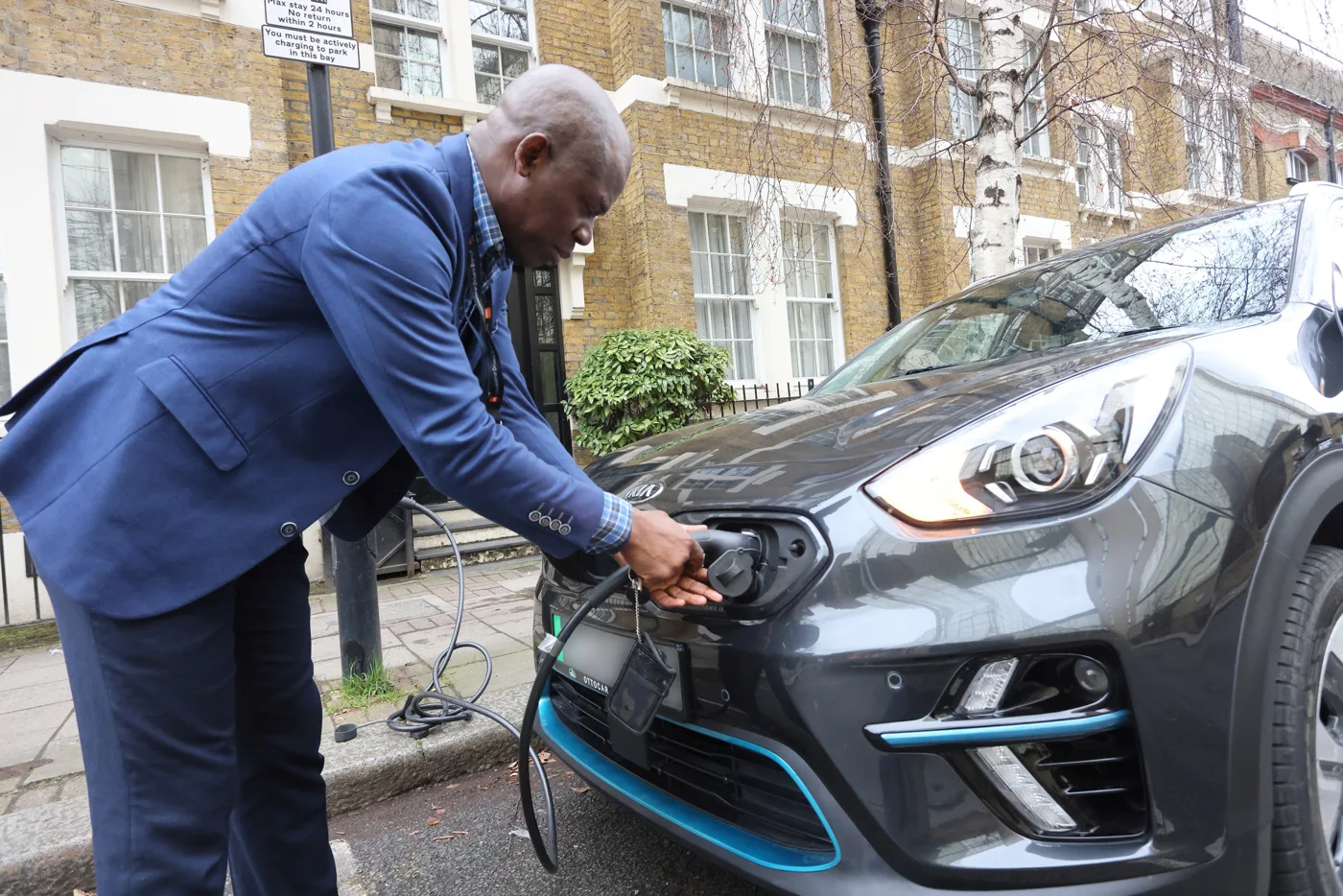

TfL wants newly licensed minicabs to be fully electric from 3 July 2028, and 481 private hire drivers live around Richmond. You can comment until 2 December.
Every minicab newly licensed in London, including any bought by the 481 private hire drivers who live around Richmond and Twickenham, would have to be fully electric from 3 July 2028 under a plan Transport for London (TfL) has put out to consultation. Anyone can respond until 23:59 on Wednesday 2 December.
Plug-in hybrids, which meet the rules today, would no longer qualify as new entrants. Wheelchair accessible minicabs would get two more years, until 1 July 2030.
TfL announced the proposals on 22 October, saying that the “vast majority of newly licensed private hire vehicles could be zero-emission from 2028”. London’s black cabs are not part of the electric requirement, although TfL says it “continues to consider proposals for a zero-emission requirement for London taxis in the future”.
Who it touches around Richmond
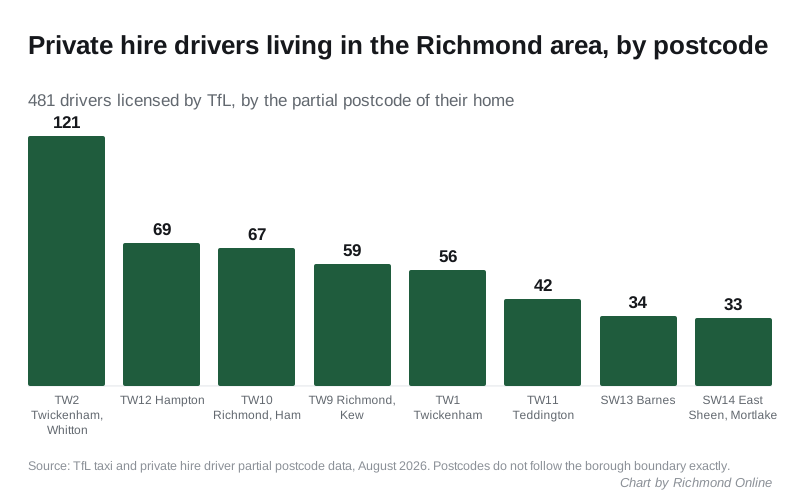
TfL’s licensing figures for August 2026 record drivers by the first part of their home postcode. The eight districts we cover hold 481 private hire drivers, out of 111,937 across the whole list, along with 70 taxi drivers.
The largest group by far is in TW2, with 121 drivers. Then come TW12 with 69, TW10 with 67, TW9 with 59, TW1 with 56, TW11 with 42, SW13 with 34 and SW14 with 33. Postcode districts do not follow the borough boundary exactly, and Hampton Wick, which shares KT1 with Kingston, is not counted.
TfL’s case for minicabs is that they fill gaps in public transport, and this borough has an obvious one: it has no Night Tube station, as we reported today.
What TfL is proposing
Two dates cover the main change, in the consultation:
- 3 July 2028: all private hire vehicles new to licensing in London must be fully electric, apart from wheelchair accessible ones.
- 1 July 2030: wheelchair accessible private hire vehicles new to licensing must be fully electric too.
These apply to cars presented for licensing in London for the first time. TfL’s notes add that a compliant vehicle is “highly likely” to be fully electric, “but vehicle models may come forward that use alternative, compliant technology”.
Three more changes would start on 1 March 2027:
- Conversions: TfL would stop approving new fuel conversion systems, such as liquefied petroleum gas and compressed natural gas, and new exhaust abatement systems. Vehicles already fitted with approved systems could stay licensed until their age limit.
- Lapsed licences: the longest gap allowed between a taxi or private hire licence expiring and a new one starting would fall from 24 months to 12. After that, the vehicle counts as new to licensing.
- Age limit: no private hire vehicle could stay licensed beyond the day it reaches 10 years old. At present a car can be relicensed at 10 and run until the day before it turns 11. TfL says existing exemptions would remain.
Why TfL says it is needed
About 7 in 10 London minicabs can already run without exhaust emissions for part of a journey. As of September 2026, 35.5 per cent of the 94,661 vehicles licensed were fully electric and 35.2 per cent were plug-in hybrids. In the past 12 months, 39 per cent of those new to licensing were fully electric.
TfL’s objection to hybrids is what they do in real use. In its supporting paper, 94 per cent of private hire drivers with a plug-in hybrid told a 2024 survey that they spent 50 per cent or less of their time in electric mode.
Mileage is the other argument. TfL says a minicab averages 30,500km a year, about three times an ordinary London car, although the figure may include trips outside the capital. The release and supporting paper put the car at about 9,400km, while the consultation page says 10,600km.
TfL forecasts a nine per cent cut in private hire NOx emissions and a 35 per cent cut in CO2 over the first ten years, compared with staying on the current rules. Over eighteen years, it forecasts a 97 per cent reduction.
The gain would not fall evenly. TfL’s 2024 estimates put minicabs at 10 per cent of road transport PM2.5 and CO2 in central London and 4 per cent of NOx. In outer London, which takes in most of this borough, they are 2 per cent of PM2.5 and CO2 and 1 per cent of NOx.
What TfL and City Hall said
Christina Calderato, Director of Strategy at TfL, said: “We recognise the crucial role that London’s private hire services play for customers, providing a vital door-to-door service. This is especially true where the public transport network has gaps or cannot yet meet all our customers’ needs.
“However, this isn’t the only role they play. Private hire vehicles are also a vital component in London’s transition to becoming a more sustainable and healthier city with less pollution. Building on the progress that has already been made, this consultation sets out our proposals to strengthen those achievements and drive forward the transition towards a zero-emission fleet.”
Seb Dance, Deputy Mayor for Transport, said: “London’s private hire vehicles play a vital role in keeping the capital moving, providing an accessible door-to-door service for millions of people, and we want to ensure they can continue doing so sustainably for years to come.
“The Mayor and I are proud that London’s PHV drivers have led the way in adopting zero-emission capable (ZEC) technology, with more than 70 per cent of their vehicles now ZEC, but there is more to do. That’s why we’re consulting on these proposals, which would help improve air quality, protect Londoners’ health and support our efforts to tackle the climate crisis.
“I encourage everyone to take part in the consultation as we continue building a greener, cleaner and more sustainable London for all.”
The cost, by TfL’s own account
Charging is where TfL concedes the plan could hurt. Its paper says drivers who rely on public chargers “are likely to experience a greater negative financial impact”. Charging at home or on low-powered street chargers is significantly cheaper than petrol or diesel, it says, but rapid and ultra-rapid public charging costs more than either. Zapmap’s August 2026 price index, quoted in the paper, averages 54p per kWh for slower public charge points and 77p for rapid and ultra-rapid ones.
In TfL’s latest licensee survey, 31 per cent of private hire drivers with a plug-in car charged on their own driveway or in a garage, and 27 per cent used low-powered street chargers. A home charge point costs about £1,000, with a government grant of up to £350 for some installations. The government’s grant for eligible electric cars is £1,500 or £3,750, and £2,500 for wheelchair accessible vehicles.
TfL says London has more than 29,500 public charging devices, more than 2,000 of them rapid or ultra-rapid, a total it sources to Zapmap. Its property company, Places for London, opened the first of at least 25 planned hubs with the operator Fastned at Hatton Cross, near Heathrow, in spring 2026, with 12 ultra-rapid bays.
Overall, TfL does not expect a negative financial effect on owners, and its draft impact assessment does not expect fares to rise. It also points out that TfL does not regulate private hire fares, so drivers “may opt to increase their fares” if their costs go up.
Passengers who use a wheelchair have the most at stake. Wheelchair accessible vehicles are just 0.4 per cent of the fleet, and TfL says the later date is there so that the rules do not reduce their availability further. The assessment accepts there could be a negative impact on disabled people if availability falls or fares rise for those not eligible for a Taxicard.
What it means for you
If you drive a minicab: a car already licensed does not have to change under the 2028 rule, but its licence must not lapse for over 12 months. Your next vehicle, if it is new to licensing in London after 3 July 2028, would need to be fully electric, and the shorter age limit could bring forward that purchase from March 2027.
If you book minicabs: nothing changes yet, and TfL does not expect fares or the number of cars to change. If you rely on a wheelchair accessible vehicle, this is the part of the consultation to read closely.
If you want a say: the survey should take no more than 10 minutes, and there is also a quick response option. Easy Read, audio and British Sign Language versions are on the same page. You can also ask questions through the page, use TfL’s call-back service on 020 3054 6037, or write to FREEPOST TFL HAVE YOUR SAY.
These are proposals, not decisions. After 2 December, TfL says it will consider the responses and publish a consultation report on the same page, and it will write to everyone who took part.
Have your say