

The Heathrow third runway consultation closes 11.59pm on 1 September. What the draft policy actually proposes, and three ways Richmond residents can respond.
The government’s consultation on the planning framework for a third runway at Heathrow closes at 11.59pm on Tuesday 1 September 2026, and it is the last chance most Richmond residents will get to comment before the policy is put to a vote in Parliament. The Department for Transport published the draft on 18 June and held exactly one public information event during the whole ten and a half weeks: an online meeting on Wednesday 12 August, from 2pm to 3.30pm, which has now passed.
Richmond Council called that timing “deeply disappointing”. Councillor Julia Neden-Watts, chair of the council’s Environment, Sustainability, Culture and Sports Committee, said holding the event “in the middle of a Wednesday afternoon, during the school holidays and just 13 days from the end of the consultation, risks excluding many of the people most affected by these proposals”. The council held its own community conversation on 23 July, which it says drew more than 100 residents, and it will submit a formal objection of its own.
What follows is drawn from the DfT’s own consultation document rather than from anyone’s summary of it, because several of the things that matter most to people living under the approach are not in the press releases.
What is actually being consulted on
This is not a decision on whether the runway gets built. It is a review of the Airports National Policy Statement, the 2018 document that sets the rules any Heathrow expansion application would be judged against. The Transport Secretary, Heidi Alexander, launched the review on 22 October 2025. It concluded the 2018 statement should be amended rather than withdrawn, and renamed the Heathrow Expansion National Policy Statement, or HENPS.
The draft applies to a development consent application covering:
- a Northwest Runway of up to 3,500m, forming part of a scheme capable of enabling at least 260,000 additional air transport movements a year
- new terminal infrastructure, or reconfiguration of the existing terminals
- associated surface access facilities and changes to the strategic road network
The draft also designates the whole thing as Critical National Growth Infrastructure, a status that signals how much weight government wants a future decision maker to give it.
The four tests, and what the noise one says
The government has set four tests that expansion must meet. In the draft’s own terms:
- Air quality: with appropriate mitigation, the scheme “would not cause air quality impacts that result in any new breaches or make existing breaches materially worse than legal obligations on air quality”.
- Noise: “overall aircraft noise must be limited, and where reasonably possible, reduced compared to a 2024 baseline taking account of quieter aircraft and operating procedures.”
- Climate change mitigation: any increase in carbon emissions “must not be so significant that it would have a material impact on the ability of the government to meet its carbon reduction targets”.
- Economic growth: the applicant must show through a “clear, evidence based growth strategy” that benefits will be realised nationally, regionally and locally.
The noise wording repays a second read. The test is about overall aircraft noise measured against a 2024 baseline, and it allows for reduction only “where reasonably possible”. The proposed noise limits themselves are unchanged from current policy at 51dB for daytime and 45dB for nighttime. The existing mitigations, a noise envelope, a runway alternation scheme and a ban on scheduled night flights, all stay as they were.
The one genuinely new question on night flights is narrow and technical, and it is worth answering if you are woken by early arrivals. The DfT asks whether the ban on scheduled night flights should be defined by the time a plane takes off or lands, rather than the current definition of departure from and arrival to the terminal. Those are not the same moment, and the gap between them is where early-morning movements sit.
The government’s own appraisal says “major adverse”
The consultation is published alongside an Appraisal of Sustainability, which the Transport Secretary is required to carry out under the Planning Act 2008. Its finding on a Northwest Runway scheme is set out plainly in the consultation document: at a strategic level it would have a major adverse effect on air quality, biodiversity, climate change in relation to adaptation and mitigation, the historic environment, landscape, noise, resources and waste, soil and water.
On communities and quality of life the appraisal finds significant adverse effects at the local scale and significant beneficial effects at a wider scale, so mixed overall. On the economy it finds significant beneficial effects for the local economy during operation, but says national effects are uncertain, because “a proportion of activity may reflect changes in where economic activity takes place rather than wholly additional growth”.
That is the government’s own assessment, in the government’s own document, and it is more candid than most of the coverage around it.
What else changed since 2018
Two additions are worth knowing about because they affect the ground rather than the air. There is a new domestic connectivity section, which would require an applicant to publish a domestic connectivity delivery report, discount airport charges for domestic flights and set up a domestic route development fund. And the surface access section has been rewritten to add passenger mode share requirements, a staff travel plan, a requirement to minimise and mitigate additional traffic, and a plan for delivering new rail infrastructure. Chapter 4 also picks up biodiversity net gain and place making to match current legislation.
How to respond, and what counts
Three routes, all in the DfT’s how to respond section:
- The online form, which lets you save and continue if you cannot finish in one go.
- Email to henpsconsultation@dft.gov.uk. You should get an acknowledgement; if nothing arrives within 15 minutes, check spam, then email again with “missing receipt” in the subject line.
- Post to the Airports National Policy Statement Review Team, Great Minster House, 33 Horseferry Road, London, SW1P 4DR.
One line in the document is the single most useful thing in it for anyone about to write a response. The government says it “will give greater weight to responses that are based on argument and evidence, rather than simple expressions of support or opposition, and those that provide reference to the specific sections of the draft HENPS to which their comments relate”.
In other words, a paragraph saying you oppose the runway carries less weight than a paragraph saying which test you think is wrongly set and why, with the section named. The questions asked include the assessment of need, each of the four tests separately, whether the proposed mitigation measures are deliverable, effective and proportionate, the night flight definition, the Critical National Growth Infrastructure designation, whether compensation for affected residents is fair, surface access and mode share, whether the Making Best Use policy should be updated, and whether the draft provides an effective framework for decisions. Anything sent after 11.59pm on 1 September will not be accepted.
What happens next
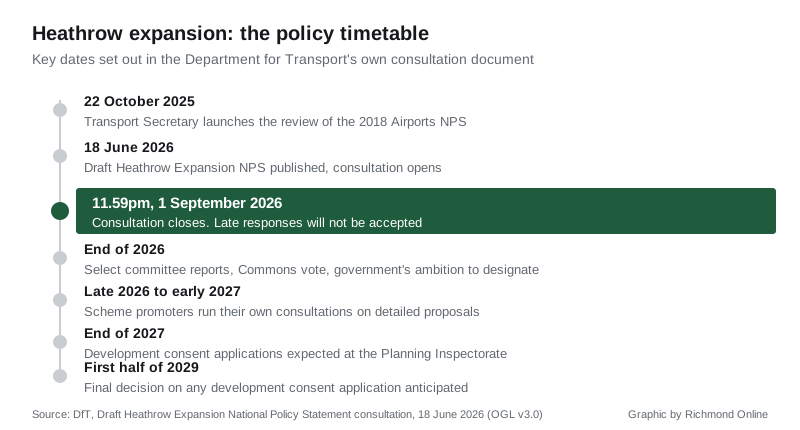
After 1 September the draft goes to a nominated parliamentary select committee, which will take evidence and report. The government then decides whether to proceed, publishes a formal response, updates the draft and lays a final version before Parliament, where it is subject to a vote in the House of Commons before it has legal effect. The government’s stated ambition is to designate the final HENPS by the end of 2026.
Only then does the scheme itself start. Promoters would run their own consultations on detailed proposals in late 2026 or early 2027, submit development consent applications by the end of 2027, and a final decision is anticipated in the first half of 2029. Anyone can register as an interested party at the examination stage, but that is years away and it examines a scheme against the policy rather than the policy itself. This fortnight is the window for the policy.
What it means for you
If you live in Kew, Mortlake, Barnes, North Sheen, Richmond, Twickenham, Teddington or Hampton, aircraft noise is not an abstraction and you already know which weeks the alternation pattern puts you under the approach. The practical points:
- The deadline is a hard cut-off. 11.59pm on Tuesday 1 September 2026. Late responses will not be accepted.
- Name the section. The DfT has said in writing that argued responses referencing specific parts of the draft carry more weight than statements of support or opposition.
- The night flight question is a real one. If the definition changes to when a plane takes off or lands, the scope of the ban changes with it.
- You can respond even though the public meeting has gone. The 12 August event was information only; it was never the route to responding.
- Richmond Council is objecting separately. Its response does not replace yours, and the DfT counts organisational and individual responses differently.
Richmond Online will report the outcome when the government publishes its formal response and the select committee reports. For the borough’s other live planning matters, see our Richmond planning news page, and for what is dug up and closed on the roads this month, the roadworks and travel page.
Sources
- Department for Transport, Draft Heathrow Expansion National Policy Statement: consultation on proposed amendments, published 18 June 2026, closing 11.59pm 1 September 2026. Contains public sector information licensed under the Open Government Licence v3.0.
- London Borough of Richmond upon Thames, Richmond Council urges residents to take part in Heathrow consultation despite ‘poor timing’, 4 August 2026.
Have your say