
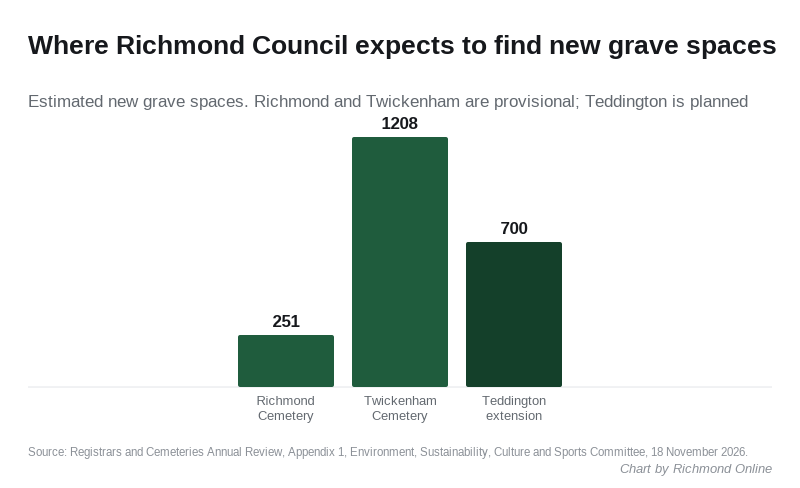
Richmond and Twickenham cemeteries have about 1,459 new grave spaces, seven to ten years' worth. A Teddington extension would add about 700 more, around 30 years.
Richmond’s council cemeteries have room for about 1,459 new graves, enough for seven to ten years. The estimate comes from an independent review of burial space across the borough.
A planned extension at Teddington Cemetery would add about 700 spaces, which the council puts at around 30 years of capacity. The review says burials can continue to 2051, but only if the space is checked, land is protected and new capacity arrives in time.
The findings are in the Registrars and Cemeteries Annual Review. It goes to the Environment, Sustainability, Culture and Sports Committee at York House on Wednesday 18 November.
Overview
- New grave spaces now: about 1,459, at Richmond Cemetery (251 estimated) and Twickenham Cemetery (1,208 mapped). Both figures are provisional.
- How long that lasts: seven to ten years, the council estimates.
- Teddington extension: about 700 planned spaces, around 30 years of capacity, not counted in the 1,459.
- Grave reuse: being kept under review. No decision is being made now.
- Next step: a draft Cemeteries Strategy returns to councillors in spring 2027.
What each cemetery is for
The review recommends running the council’s six working cemeteries as one network, each with a clear role. The summary presentation sets them out:
| Cemetery | Role in the plan |
|---|---|
| Richmond | Burials continue. Remaining space still to be checked |
| Twickenham | The main future burial site, developed in stages |
| Teddington | Family graves and ashes, plus the planned extension |
| East Sheen | Existing rights, burials in family graves, ashes and memorials |
| Hampton | Mainly ashes and memorials, with burials in family graves where allowed |
| Old Mortlake | Heritage and remembrance, and existing rights |
Families who already hold the right to a grave can still use it where the rules allow. At Twickenham, the council will track space for different types of burial separately, including natural burials.
The council also looks after 12 closed burial grounds and churchyards. They include Barnes Old Cemetery, the Vineyard Passage burial ground in Richmond and St Andrew’s Churchyard in Ham.
Reusing old graves
The presentation says reusing or reclaiming old graves “could free up burial space in existing cemeteries”. It adds that legal advice, checks on records and ground conditions, and public consultation would all be needed first.
The council is not making a decision on this. The report says any such proposal will need its own legal advice before councillors are asked to decide.
The council is also exploring working with neighbouring boroughs on future burial space. The draft London Plan includes a policy, HN10, on burial space, and officers’ comments on it support protecting land for future burials.
How busy the service is
Between January 2025 and May 2026 the cemeteries handled 360 interments: 201 full burials and 159 burials of ashes. The chapels held 58 services.
The registrars conducted 1,205 marriages and civil partnerships in 2025/26. They also handled 146 citizenship ceremony appointments.
Bats at Twickenham Cemetery
A 2024 survey recorded seven species or groups of bats at Twickenham Cemetery, the presentation says. The Richmond Biodiversity Bat Species Action Group placed a detector there in August and September 2024. The common pipistrelle was the most recorded, with 1,415 calls.
Plans for the cemetery include bat and bird boxes, pollinator planting, a stag beetle loggery and hedgehog routes.
What it means for you
Nothing changes yet for families arranging a burial. The report asks councillors only for their views, and seeks no money or policy decision.
The council will test its priorities with bereaved families, faith and belief groups, funeral directors and local residents before the draft strategy. That engagement is due to finish by early 2027. The report does not yet say how residents can take part.
The first step is checking how much space is really left. The report names “unverified burial capacity” and delay in bringing new land into use as the main risks.
Have your say