
Richmond Council has approved hiring Newton, for about £10m, to help cut £21.3m a year from social care and homelessness costs. The fee depends on the savings being made.
Richmond Council has agreed to hire the consultancy Newton to help it save £21.3 million a year in adult social care, children’s social care and homelessness. Richmond’s share of the one-off fee is about £10 million.
Councillors on the Finance, Policy and Resources Committee approved the appointment on Thursday 19 November, the council’s decision record shows. The final contract sum and terms are left to the Executive Director of Finance, after talking to the committee chair and the Lead Member for Finance and Resources. The details are in the committee report published with the meeting agenda.
The same agenda shows the council’s overspend this year has almost doubled since the summer, to £5.9 million.
Overview
Updated 23 November: councillors approved Newton’s appointment on 19 November, the decision record shows, with the final contract sum and terms delegated to the Executive Director of Finance.
- Who: Newton Consulting Limited, already working for the council since January 2026.
- Fee: about £10 million for Richmond, one-off, in a joint contract with Wandsworth Council.
- Savings promised: £21.3 million a year by 2030/31, more than half of the council’s £39 million savings plan.
- The safeguard: the whole fee depends on the savings being made. If none are agreed, the council pays nothing.
- Decision: approved by the Finance, Policy and Resources Committee on Thursday 19 November. The final contract sum is still to be agreed.
Where the savings would come from
Newton staff would work inside council teams in the services that cost the most and face the most demand. The report lists six areas:
- reducing, delaying and preventing the need for adult social care
- adult social care operations and models of care
- children in care
- a redesign of children’s services
- placements and commissioning for children
- homelessness and temporary accommodation
The report sets out how the yearly saving builds up:
| Area | 2027/28 | 2030/31 |
|---|---|---|
| Adult social care | £3.7m | £9.8m |
| Children’s social care | £4.7m | £5.4m |
| Homelessness and temporary accommodation | £1.2m | £2.4m |
| Adult social care redesign | £0.5m | £1.8m |
| Children’s services redesign | £0.5m | £1.9m |
| Total | £10.5m | £21.3m |
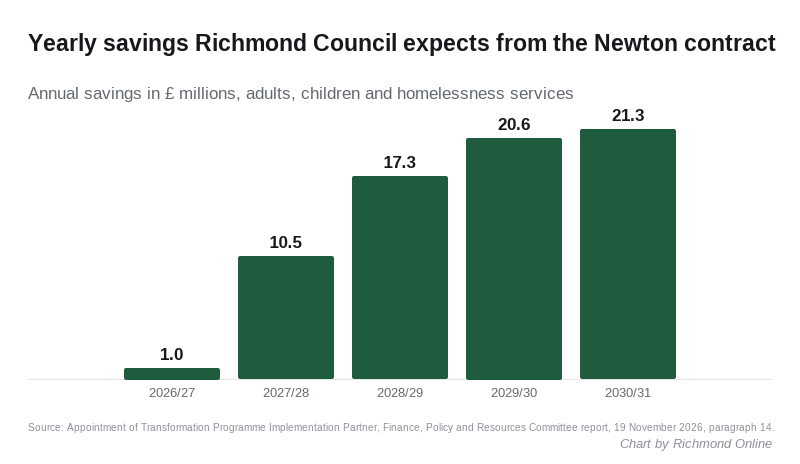
Over the five years, the report puts the total saved at £70.7 million.
The council will track measures such as fewer people starting in residential and nursing care, more children in care living with foster or kinship families, and fewer households entering temporary accommodation. It will also track the average nightly cost of temporary accommodation.
How the fee works
The report says 100% of Newton’s fee is “contingent” on a guaranteed level of yearly savings. If Newton delivers less, the fee falls in proportion. The report says the council would “end up paying Newton nothing” if no savings were delivered or agreed.
Other terms in the report:
- the council can pause invoices for up to three months if delivery falls behind plan
- the council can end the contract at any time on four weeks’ notice, paying only for work done
- Newton has no matching right to walk away
- the fee is fixed, so extra work by Newton costs the council nothing more
The report expects a return of more than two to one, with the fee paid back during 2027/28. The final contract sum would be agreed by the council’s Executive Director of Finance after talking to the committee chair and the lead member for finance.
The money would come from a Transformation Programme Delivery Fund, set up from the council’s reserves in September.
How Newton got the job
The committee agreed in July 2025 to hire a “strategic transformation partner”. Newton won the job after a competitive tender and has spent this year looking for savings across the council. The report says the original tender allowed the contract to be extended for up to three years, so no new tender is needed.
Officers argue that a new firm “would find it necessary to re-evaluate opportunities identified to date”, adding cost and delay. The report says Newton has worked with more than 40 councils.
Wandsworth Council, which shares many staff with Richmond, will decide on its part of the contract at its Cabinet meeting in December.
The overspend has nearly doubled
The council’s budget monitoring report for July to September forecasts a £5.9 million overspend this year. Three months earlier the forecast was £3.1 million.
The council had already planned to use £15 million of reserves to balance this year’s budget. The overspend pushes that to £20.9 million.
The biggest pressures by committee:
- adult social services, health and housing: £3.2 million over, mainly temporary accommodation, prevention and staffing
- education and children’s services: £1.6 million over, including £1.4 million on placements for children in care
- environment, culture and sports: £1.0 million over, including £452,000 on waste
- finance and resources: £355,000 over, mainly from lower rent at Richmond Riverside
The report says some of the £5.6 million of savings the council counted on in the summer “are now not realisable”. Spending panels now check discretionary spending, recruitment and agency staff across the council.
What it means for you
No service changes were decided on 19 November. The report says there is no consultation on the contract itself, and that any change to services that comes out of the work will be consulted on “in accordance with Council policy” when it happens.
The areas in the contract are the ones residents meet when they need care for a parent, help for a child or a roof over their head. The council says it wants more people supported to stay independent at home and fewer families in temporary accommodation.
Residents can still tell the council which services matter most to them in its spending survey, open until 13 December.
The meeting at York House is open to the public and is webcast. Agendas and reports are on the council’s committee website.
Have your say