
Richmond plans to raise the housing register residency rule from 3 to 5 years and reward homeless families who rent privately. Consultation starts in October.
Richmond Council wants to change who can join its housing register and how social homes are handed out. The last major review of the rules was in 2017.
The biggest change for most applicants is the residency test. At the moment you must have lived in the borough for three years without a break. The council proposes five years out of the last seven.
The Adult Social Services, Health and Housing Committee noted the proposals on 8 September and agreed £150,000 to pay for the work. That is recorded in the committee’s printed decisions. Nothing changes yet. A public consultation is due to start in October.
Why the council wants to change the rules
The aim is to cut the number of households in temporary accommodation, and its cost. The committee report says each household in temporary accommodation costs the council about £16,000 a year.
The pressure is growing. The council’s first-quarter budget report says about 10 households currently enter temporary accommodation for every one that leaves. The ambition is to reverse that, so that 10 leave for every three that arrive.
Other councils that made similar changes reported 10% to 20% fewer households going into temporary accommodation, according to the report. Applied to Richmond’s 2025/26 figures, officers estimate that would mean 40 to 80 fewer households and £0.64m to £1.28m a year in costs avoided.
The register is large. There were 2,383 applicants on it at 31 March 2026, according to the council’s equality impact assessment.
What is proposed
The full list is set out in Appendix 1 of the report. In summary:
- Residency: five years out of the last seven, instead of three unbroken years. Meeting it would also earn 50 extra points.
- Homeless households who find a private rental would keep their place, their band and their registration date. Today, finding a private let ends their right to stay on the register. They would also get 50 extra points.
- Choice for some applicants: people who move into private rentals, and existing social tenants seeking a transfer, could bid for homes they want. Households still in temporary accommodation would keep getting a direct offer.
- Single homeless people could be offered one-bedroom flats, not just studios.
- Band A removed for accepted homeless households in bed and breakfast, and for “urgent” cases in temporary accommodation. A senior officer panel would consider exceptional cases.
- Downsizing social tenants would reach Band A by giving up one spare bedroom, rather than two, plus 25 points per bedroom released.
- Five years in temporary accommodation would earn 50 extra points.
- Over-55s who qualify for sheltered housing would join that list automatically, without a separate application.
- Domestic abuse survivors placed in Richmond by another council, and care leavers looked after by another council, could join the register. They would sit in a lower band than people Richmond owes a duty to.
How Richmond compares
The report benchmarks both the residency rule and waiting times against other London councils.
On residency, Kingston and Southwark already ask for five unbroken years, and Croydon six. Camden and Hammersmith and Fulham use the same “five out of the last seven” test Richmond is proposing. Merton asks for one year, and Lambeth and Sutton two.
On waiting times, Richmond is quicker than most. The table covers households in temporary accommodation who secured a social home in 2025/26.
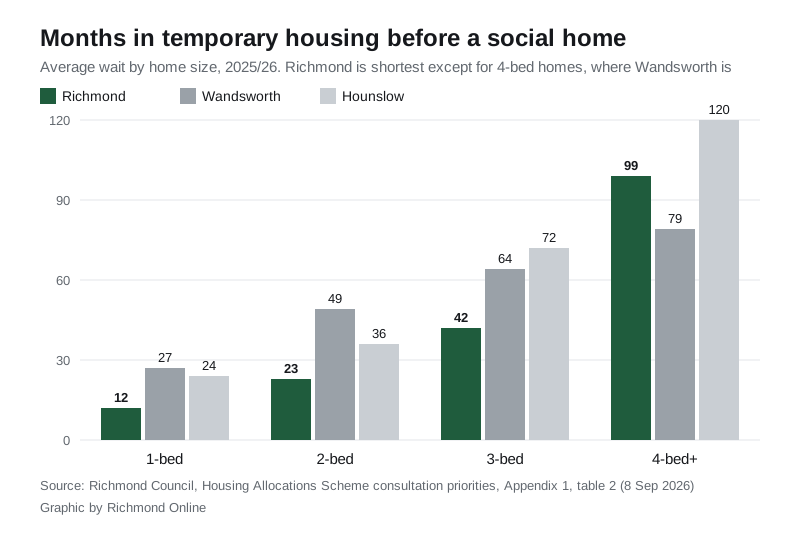
| Home size | Richmond | Wandsworth | Hounslow |
|---|---|---|---|
| 1-bed | 12 months | 27 months | 24 months |
| 2-bed | 23 months | 49 months | 36 months |
| 3-bed | 42 months | 64 months | 72 months |
| 4-bed or larger | 99 months | 79 months | 120 months |
A family needing four bedrooms waits more than eight years on average. That is why the council wants to reward tenants who free up spare rooms.
Kingston, Merton, Westminster, Camden, Islington and Hammersmith and Fulham do not publish comparable waiting times, the report says.
Who could lose out
The council’s own equality assessment flags two risks.
- The longer residency test “may negatively affect” applicants who cannot prove five years in the borough, including refugees. Allowing breaks and exempting some groups softens this, it says.
- Removing Band A takes away enhanced priority from households with acute problems in their temporary accommodation. The council says it will fix the accommodation instead.
For homeless applicants, the report lists exceptions to the residency rule for people fleeing domestic abuse or threats of violence, former looked-after children and former members of the Armed Forces.
When it would happen
The timeline in Appendix 2 is marked as indicative:
- October 2026: consultation starts
- February 2027: consultation ends
- June 2027: committee decides which changes to adopt
- July 2027: every applicant told how they are affected
- September 2027: reassessment of all applications begins
- March 2028: new scheme in force
What it means for you
If you are on the register now, the council’s timeline does not bring in new rules before March 2028. The council says every applicant will be written to, and every application reassessed, if the changes are adopted.
If you are thinking of applying, the current three-year rule still applies. If you have not yet reached three years, bear in mind the test could become five out of seven before you qualify.
If you are homeless or in temporary accommodation, the proposals are aimed mainly at you. The council plans daytime and evening workshops, in person and online, and letters to homeless households, register applicants and council tenants. Paper surveys will be available on request.
If you are a social tenant with a spare room, the plan would make downsizing a faster route to a smaller home.
The consultation has not opened yet. We will report the dates and how to respond when the council publishes them.
Have your say