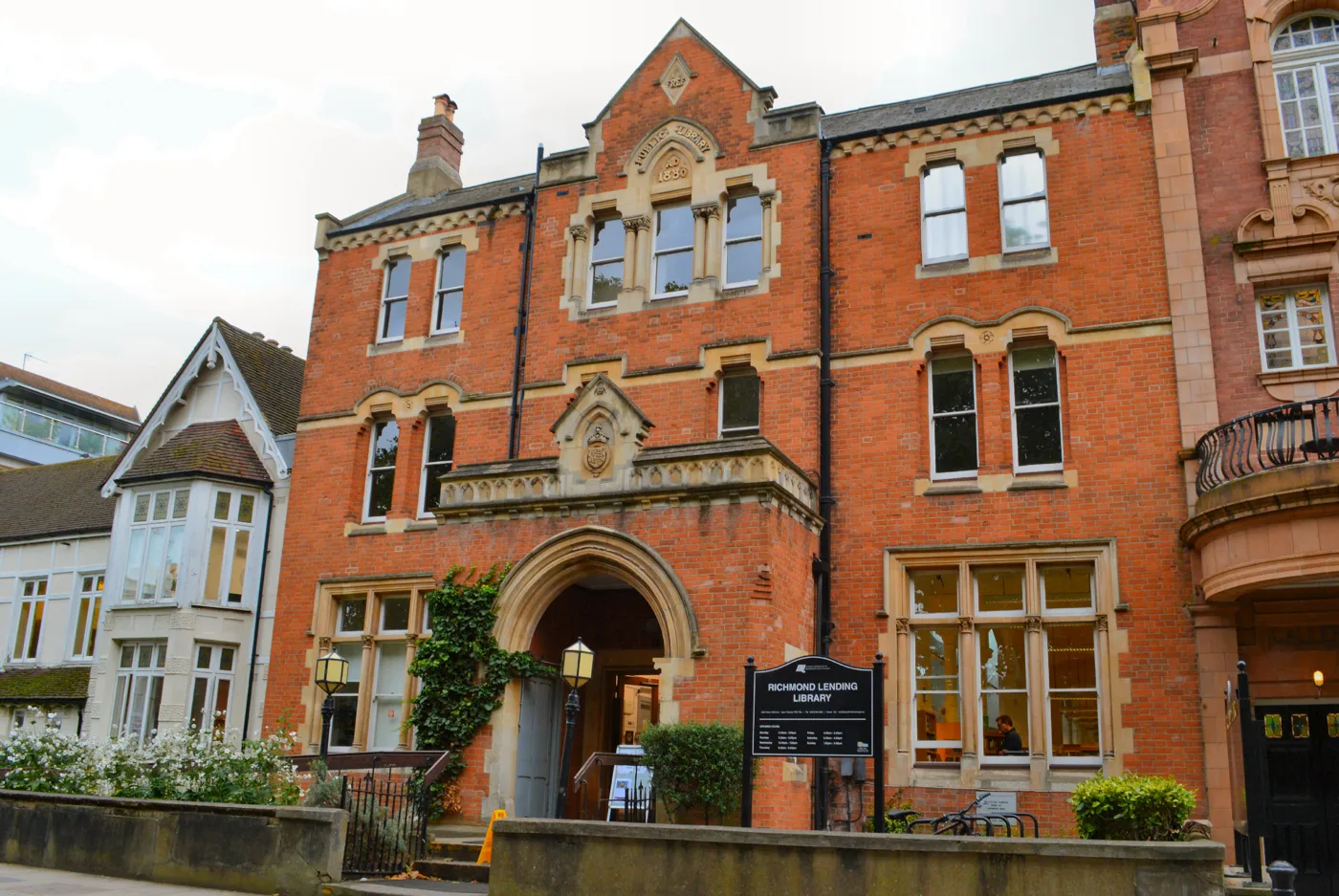

Richmond Council wants to test whether an outside firm or trust could run its 12 libraries and save £500,000 a year. Councillors decide on 18 November.
Richmond Council wants to find out whether an outside organisation could run the borough’s 12 libraries. Officers say the service must save at least £500,000 a year from 2028/29.
Councillors on the Environment, Sustainability, Culture and Sports Committee will decide on Wednesday 18 November whether to start a tender. The committee report says a tender “does not commit the Council to outsourcing or contract award”. Either step would need a further committee decision.
The same report asks councillors to cut the book and digital budget by £43,000 a year straight away.
Overview
- What is proposed: a competitive tender to test whether an outside provider, a trust or a partnership could run Richmond’s libraries more cheaply.
- Why: the council says it faces a £29 million cut in core government funding by 2028/29, and the library service must save £500,000 a year from that year.
- When: the committee decides on 18 November. If it agrees, a decision on any contract would come in October or November 2027, with a new operator starting on 1 April 2028 at the earliest.
- Straight away: £43,000 a year less for books and online resources, including no more DVDs and no new reference books at the Old Town Hall.
What councillors are asked to agree
The report makes four recommendations:
- run a competitive tender to test “alternative delivery models”, with the detail left to the executive director for environment and the committee chair
- develop a “Core Plus” model, in which every library keeps a core service and adds other uses to suit its area
- cut the annual stock fund by £43,000, the smallest of three options officers costed
- bring a further report back to the committee to choose a delivery model
Officers estimate an outsourced service could save about £500,000 a year after three years of operation. The report says that figure still needs testing through the tender.
Why the council says it has to act
The report opens with the government funding settlement. It says Richmond faces cuts to core funding of £29 million by 2028/29, equal to 58% of its core funding allocation and “the largest percentage cut in London”. The council’s wider spending review survey on which services to protect is open until 13 December.
The supporting slides add that the library service reports an overspend of up to £150,000 a year. Staffing pressures cause it, and branches “already run with minimum staffing”, the slides say. Older and listed library buildings need repairs and are hard to adapt.
A well-used service that costs more than most
The papers are clear that the service performs well. Over the three years to 2024/25, Richmond’s libraries lent 4,866 physical items per 1,000 residents, the highest rate in London and third in England. They recorded 4,404 visits per 1,000 residents, second in London.
A government survey for 2025/26 found 48% of Richmond residents aged 16 and over had used a library in person in the previous year. The England figure was 31%, and the slides say Richmond’s rate was the highest of 296 local authorities.
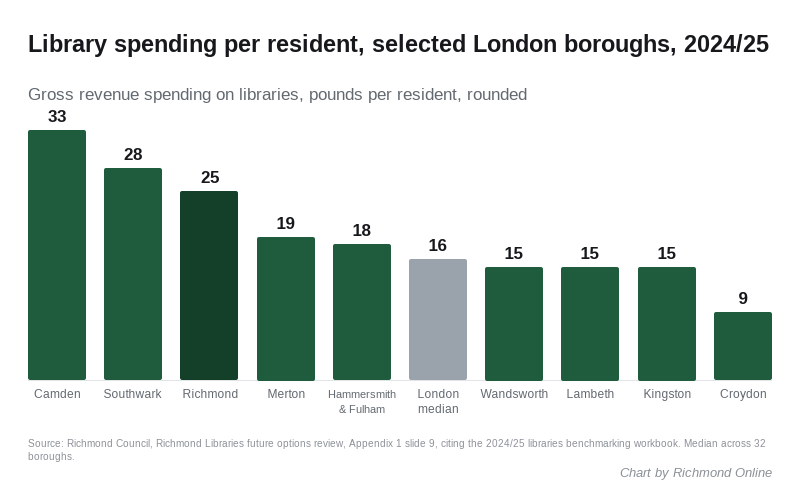
It also costs more. Richmond spent £25 per resident on libraries in 2024/25, against a median of £16 across the 32 London boroughs. Its 12 sites serve about 16,400 residents each. Kingston’s seven serve about 24,700 each.
The four ways the service could be run
The slides set out four management models for comparison:
| Model | How it would work |
|---|---|
| External provider | A contractor runs the service under a competitively procured contract, to council standards |
| Council-run | The council keeps running it, with improvements and possible joint working with Wandsworth |
| Trust or mutual | A separate organisation spun out of the council takes over management |
| Community partnership | The council runs the core network, and community groups run smaller libraries with volunteers |
Officers also want to look at the library buildings themselves. The review will consider sharing buildings with other services, moving libraries, and “consolidation or reconfiguration”. It will also test opening libraries without staff on site, using self-service technology. The slides warn that this needs safeguarding and arrangements for under-16s.
The report says it “cannot assume that branch provision, staffed hours, the service offer and delivery arrangements will all remain unchanged”.
A charity provider could also cut the business rates bill. The slides put that bill at about £231,000 a year, including the Old Town Hall.
The timetable if the tender goes ahead
The slides give an indicative timetable:
- December 2026 to March 2027: preparation, talks with potential providers and tender documents
- April to May 2027: tender launched and suppliers shortlisted
- June to September 2027: bids, negotiation and final bids
- October to November 2027: evaluation, and a committee decision on any contract
- By December 2027: contract signed
- January to March 2028: handover
- 1 April 2028: target start date
What goes from the book budget
The stock fund buys every book, ebook, magazine and online service across the 12 libraries. It is £443,100 a year. Officers costed three cuts, of £43,000, £86,000 and £133,500, and recommend the smallest.
Option A is made up of:
| Saving | Amount a year |
|---|---|
| Four online resources already ended (from March 2027) | £32,000 |
| No new reference materials for the Old Town Hall | £5,000 |
| No more DVDs | £3,000 |
| Smaller adult and children’s book budgets | £3,000 |
Existing DVDs and reference books would stay on the shelves. The larger options would have ended the CloudLibrary ebook service and, in the biggest, Ancestry Library Edition and Britannica Online.
Printed newspapers at the Old Town Hall have a separate budget. Ending them all would save £7,500 a year. Keeping only the Financial Times, which is missing from the free PressReader service, would save about £6,500. The slides contradict themselves here: one says no option is preferred, and the next recommends keeping only the Financial Times. The committee report itself says only that newspaper provision is assessed separately.
What it means for you
Nothing changes at your library yet. All 12 sites stay open, and the 18 November vote is about whether to start a tender, not about who runs the service.
The book budget cut would apply straight away if agreed. Most of it comes from four online resources the service has already stopped paying for.
The council says it will talk to library staff and unions first, then to residents and library users, “before any final decisions are made on the wider operating-model proposals”. It has not published a consultation date. The meeting starts at 7pm and the papers are on the council’s website.
Sources
- Richmond Libraries Sustainable Future Delivery Options, report to the Environment, Sustainability, Culture and Sports Committee, 18 November 2026.
- Richmond Libraries future options review, Appendices 1 to 4, for the usage figures, spending comparison, management models, timetable, stock options and newspaper options.
- Committee agenda, 18 November 2026, London Borough of Richmond upon Thames.
Have your say