
Mayors can now charge a percentage levy on overnight stays. Richmond's leader says all the money raised in the borough would go to City Hall.
The government confirmed on Thursday that mayors in England will get the power to charge a levy on overnight stays. In London that power would sit with the Mayor, Sadiq Khan. He said it “needs to happen sooner rather than later”.
Richmond Council’s leader, Councillor Gareth Roberts, called the announcement “another kick in the teeth for Richmond”. He said the idea of a tourist tax “has merit”. His objection is that the money raised in the borough would go to City Hall and leave “nothing for the borough”.
What the government announced
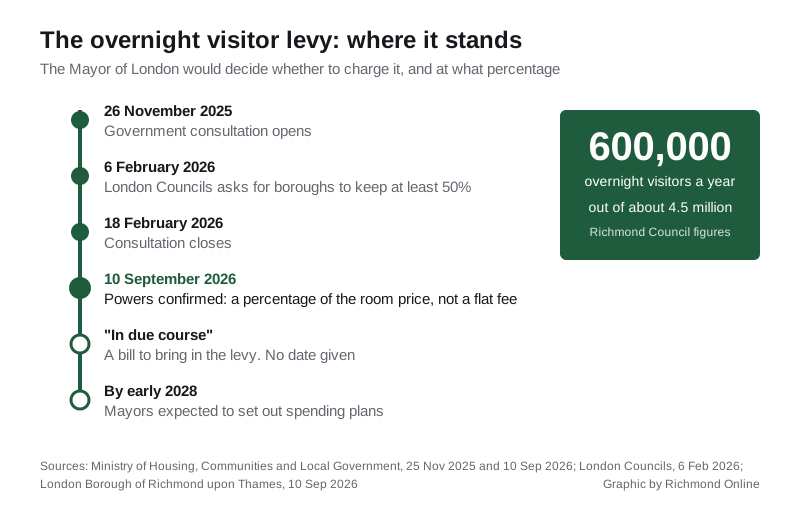
The Ministry of Housing, Communities and Local Government set out the policy in a press release on 10 September 2026. It follows a consultation that ran from 26 November 2025 to 18 February 2026.
The main points:
- The levy must be charged as a percentage of the cost of accommodation, not as a flat fee. The government says this protects cheaper holidays.
- Mayors and leaders of Foundation Strategic Authorities decide whether to introduce it and how the money is spent, “in consultation with their residents and local businesses”.
- Hotels and other accommodation providers would pay the levy to the mayor or strategic authority.
- Local leaders can offer exemptions, such as for campsites. Temporary accommodation, shelters and refuges would not be charged.
- A bill will be introduced “in due course”. Mayors are expected to set out spending plans by early 2028.
The consultation paper said the levy would apply at hotels, holiday lets, bed and breakfasts and guesthouses.
What has not been decided
A good deal, and that matters for anyone trying to work out what this costs them.
- No rate. The announcement sets no percentage and no cap.
- No start date. The levy needs a bill first, and none has been published.
- No borough share. The release gives the power and the revenue to mayors and strategic authorities. It does not mention any share for London boroughs.
Khan’s statement in the same release said he would “work closely with London’s boroughs, accommodation providers, hospitality and tourism businesses and other partners, before final decisions are taken.”
Why Richmond says it loses out
The council’s case rests on how many people visit, and how few of them stay the night.
In its statement on 10 September, the council says the borough gets around 4.5 million visitors a year. About 600,000 of them stay overnight. The rest are day visitors, who would pay nothing under a levy on stays.
Cllr Roberts listed what those visitors cost the borough. He named street bins, wear on roads and pavements, pressure on parks and the cost of promoting the borough.
“All this costs money, lots of money,” he said. Sending the money raised in Richmond “straight to City Hall is just another kick in the teeth for Richmond”, he added.
He also tied it to two earlier decisions. One was what he called the government’s decision “to strip Richmond of nearly 60% of funding to prop up councils elsewhere”. The other was the Mansion Tax, which he said would take money from some borough homeowners with none of it earmarked for local services. Those are the leader’s descriptions; the council’s statement does not link to the figures behind them.
Richmond is not alone in wanting a share
London Councils, the cross-party body that represents the capital’s boroughs, has been campaigning on this since the winter. On 6 February 2026 it called for boroughs to keep at least 50% of the money raised in their area. It also asked for a formal role in designing and running the levy “in partnership with the Mayor”.
Thursday’s announcement did not give boroughs either of those. The question now moves to the bill and to City Hall.
What it means for you
- If you live here: nothing changes yet. No levy can be charged until a bill passes and the Mayor chooses to use the power.
- If you run a hotel, B&B or holiday let in the borough: you would be the one collecting and paying it. The government says it will work with accommodation providers to keep it simple to run. The Mayor has said he will talk to the sector before deciding.
- If friends or family stay with you in a paid room: any charge would be a percentage of the room price, so cheaper rooms would pay less.
- If you want the borough to get a share: the decision is now political. The bill and the Mayor’s consultation are where that argument will be settled.
The borough’s biggest draws, Kew Gardens, Hampton Court Palace and Richmond Park, are listed on our things to do in Richmond page.
Sources
- Local leaders handed powers to drive investment in communities, Ministry of Housing, Communities and Local Government, 10 September 2026, for the percentage-based design, who decides, who pays, the exemptions, the timetable and the Mayor of London’s statement.
- Levy on overnight trips will help mayors invest in local growth, Ministry of Housing, Communities and Local Government, 25 November 2025, for the accommodation types in the consultation proposal.
- Tourist Tax plans another ‘kick in the teeth for Richmond’, claims Council Leader, London Borough of Richmond upon Thames, 10 September 2026, for Cllr Roberts’s comments and the visitor figures.
- ‘Keep the levy local’, London Councils, 6 February 2026, for the boroughs’ 50% ask.
Have your say