
Richmond Work Match has moved 337 residents into jobs at £17 an hour on average. What the free service does, and how the borough's claimant count compares.
Richmond Council’s free employment service has moved 337 residents into sustainable jobs, at an average rate of pay of £17 an hour, according to the Richmond Work Match Annual Report 2025/26 published on 11 August. The same report puts the service’s total reach at 1,236 residents engaged and 872 provided with training, counted as achievements to March 2026.
Those three figures sit inside each other, and it is worth being clear which is which, because the council’s own headline on the report, “More than 1,200 residents supported into training and local jobs”, runs the largest of them at the top. Of the 1,236 people who came through the door, 872 were put into training and 337 came out the other end in a job the service classes as sustainable. That is just over a quarter of everyone engaged, across a service the council says has been running since 2020.
The £17 an hour is the more quietly impressive number. The real Living Wage for London is £14.80 an hour for 2025/26 and the government’s National Living Wage is £12.71, so the service is not simply pushing people into the lowest-paid work available. The report says the majority of jobs sourced were in the office and clerical category.
Who is actually using it
The report names the five wards whose residents engaged with Work Match most: West Twickenham, Teddington, Twickenham, South Twickenham and North Richmond. Four of the five are on the Middlesex side of the river. That is a useful corrective to the idea that the borough’s employment support demand tracks the tourist-facing parts of Richmond itself.
The service is free to residents and free to employers. For residents it covers CVs, applications, interview preparation and confidence building. For businesses it advertises vacancies, vets candidates against criteria, builds a shortlist and arranges interviews. Two named local employers give accounts in the report: Richmond AID, whose office manager Christine Fleming calls it “an easy and efficient service to use”, and the coding club provider Code Cadets, which describes the screening as saving “a huge amount of time compared to going through countless applications myself”. Richmond Housing Partnership’s talent attraction adviser Donna Bispham says all candidates put forward were suitable for the roles.
One administrative detail worth knowing if you go looking for the service: Work Match is run through the shared staff structure Richmond has with Wandsworth, so its contact address is richmondworkmatch@richmondandwandsworth.gov.uk and its phone number is 020 8871 5191. Richmond and Wandsworth remain separate councils; the service is Richmond’s.
Councillor Phil Giesler, the council’s lead member for business and growth, said in the release: “Richmond has one of the strongest local economies in London, but we cannot take that success for granted.” The report ties the service to the Richmond Growth Plan, which the council launched in March 2026.
The wider picture: 3,285 people on the claimant count
The council is right that Richmond’s economy is strong, and the official figures put a number on it. In June 2026 there were 3,285 people on the claimant count in Richmond upon Thames, 2.6% of residents aged 16 to 64, according to ONS figures published through Nomis on 21 July 2026.
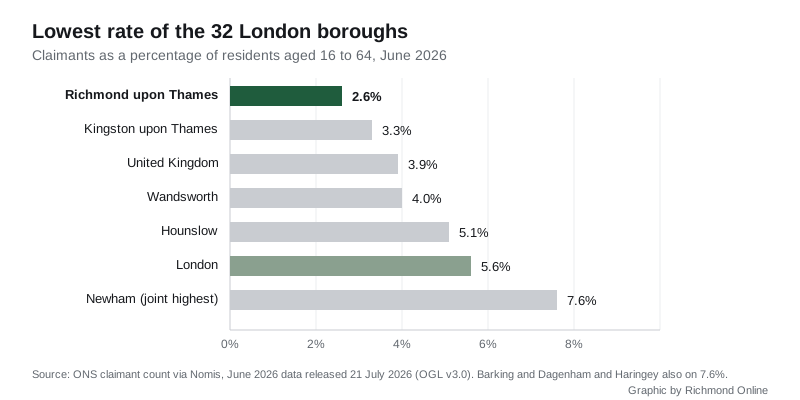
That 2.6% is the lowest rate of any of the 32 London boroughs. Only the City of London comes in under it, at 1.1%, and the City is not a borough and not a like-for-like comparison: it has 145 claimants in total and barely any residents. Among the boroughs, the next lowest are Kingston upon Thames on 3.3%, Bexley on 3.4%, and Bromley, Kensington and Chelsea and Sutton all on 3.5%. Richmond’s immediate neighbours run higher: Wandsworth 4.0%, Hounslow 5.1%. London as a whole is on 5.6%, with 353,355 claimants, and the United Kingdom is on 3.9%. Three boroughs share the highest rate at 7.6%: Barking and Dagenham, Haringey and Newham.
The trend inside Richmond is less comfortable than the ranking. The 3,285 recorded in June 2026 is the highest monthly figure in the 14 months to June 2026. The count bottomed out at 2,970 in January 2026 and has climbed in four of the five months since, passing the June 2025 figure of 3,260 along the way. The under-25s account for some of that: 380 claimants aged 16 to 24 in June 2026, against 350 a year earlier, while the 25 to 49 group edged down from 1,920 to 1,895.
One caveat that matters. The claimant count is not the unemployment rate. It counts people receiving Universal Credit or Jobseeker’s Allowance who are required to look for work, which includes some people already working but on low earnings. Read it as a measure of who is being asked to find more or better paid work, not as a headcount of people with no job at all.
What it means for you
- If you are looking for work in the borough, Work Match is free and it is a real service rather than a signposting page. It is at richmondworkmatch.org, or 020 8871 5191.
- If you are hiring, the recruitment side is also free to Richmond businesses, and the report’s employer accounts are specifically about candidate screening saving time.
- If you are reading the ranking as reassurance, be careful. Richmond has the lowest claimant rate of the 32 London boroughs and its claimant count is still at a 14-month high. Both are true.
- The next set of figures lands tomorrow. ONS publishes the July 2026 claimant count at 7am on Tuesday 18 August 2026. Richmond Online will report the borough number when it appears.
For the borough’s property market, which moves on a similar rhythm of monthly official releases, see our Richmond house prices page.
Sources
- London Borough of Richmond upon Thames, Richmond Work Match Annual Report 2025-2026 (PDF), and the accompanying release More than 1,200 residents supported into training and local jobs despite national recruitment challenges, 11 August 2026.
- Office for National Statistics, Claimant count by sex and age, via Nomis. June 2026 data, released 21 July 2026. Contains public sector information licensed under the Open Government Licence v3.0.
Have your say