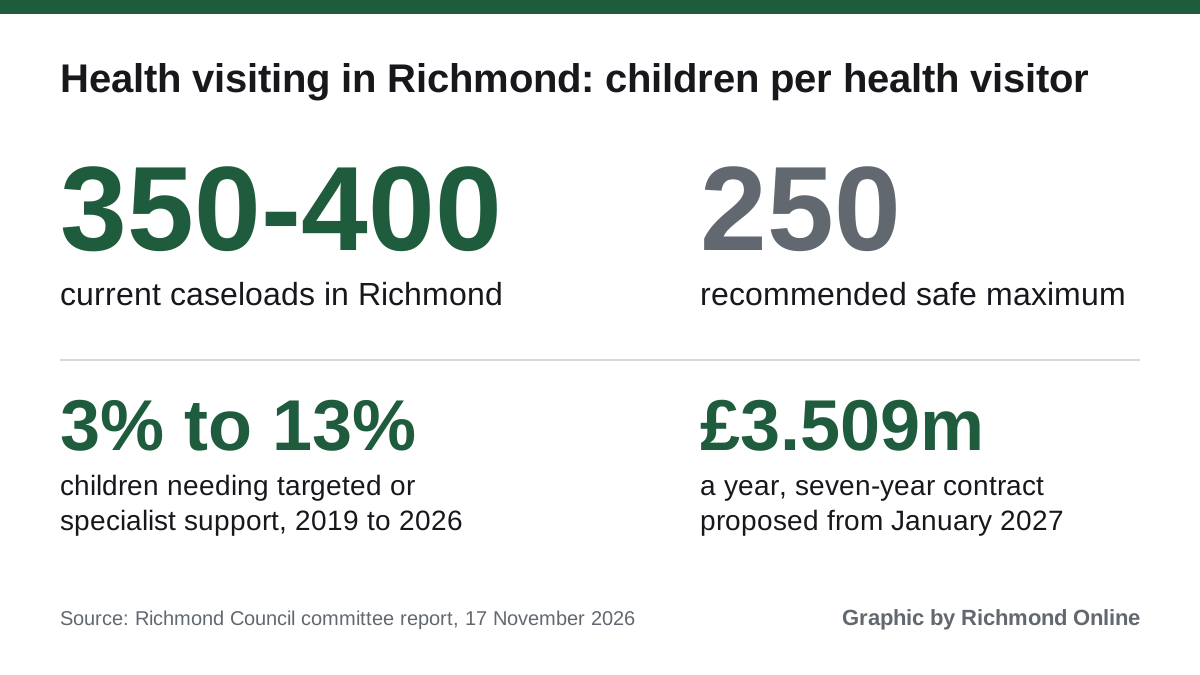

Richmond health visitors have caseloads of 350 to 400 children against a safe maximum of 250. A new seven-year contract goes to councillors on 17 November.
Health visitors in Richmond upon Thames are each looking after 350 to 400 children, a council report says. The Institute of Health Visiting recommends no more than 250.
The figures are in a report to the council’s Adult Social Services, Health and Housing Committee, which meets on Tuesday 17 November.
Councillors are asked to hand the service a new seven-year contract. It would go to the current provider, Central London Community Healthcare NHS Trust (CLCH), without a competition, from 1 January 2027. Richmond’s share costs £3.509m a year.
Fewer children, more complex needs
The report says Richmond’s child population is falling, but the needs of the children the service sees have become more complex since 2019.
It gives these figures:
- targeted (higher need) health visiting caseloads up 202% since 2019, and specialist caseloads up 247%
- children needing targeted or specialist support rose from 3% of the caseload in 2019 to 13% in 2026
- health visitor caseloads of 350 to 400 children, against the institute’s recommended maximum of 250
- school nursing caseloads up 20%, with more than 1,500 active cases and a 31% rise in what the service calls level 2 need
The report puts the number of Richmond children living in relative poverty at around 2,795. It says demand linked to mental health, special educational needs and disability (SEND), food insecurity and childhood obesity is rising.
The council says the high caseloads are “managed through a ‘skill mix’ programme”. That means more staff nurses working under a health visitor’s supervision, which the report also counts as a saving on “higher-cost Health Visitors”.
What the new contract changes
The service is run jointly with Wandsworth Council, and Wandsworth’s children’s services department currently commissions it for both boroughs. The report says responsibility moves to Richmond and Wandsworth’s shared adult social care and public health directorate in December 2026.
Councillors are asked to approve:
- keeping specialist health visitors for SEND, perinatal mental health and child accident prevention
- turning school nursing into a “population health service”, focused on prevention, mental health, long-term conditions and SEND
- scrapping ChatHealth, the school nursing text messaging service, because use “has remained consistently low despite promotion”, and putting the money into frontline staff
- closer performance monitoring of CLCH
The contract runs for two years plus five, with a break clause. The report says savings from falling birth rates will be looked at after the first two years, and that any cuts “will be evidence-based and not undermine essential prevention and early intervention”.
The award uses Direct Award Process C under the NHS Provider Selection Regime, which allows a contract to be renewed with the existing provider when changes are limited. A formal assessment against those rules has still to be completed.
The cost comes from the ring-fenced Public Health Grant. Pay awards under the NHS Agenda for Change deal would be added each year through the budget.
What it means for you
If you have a baby or a child under five, nothing changes on the day. Health visiting checks continue under CLCH, and the report says families who used ChatHealth can still reach school nurses, health visitors and the borough’s family hubs through the usual routes.
The equality assessment published with the report names Hampton North and Heathfield as the borough’s most deprived wards. It also records more than 4,200 lone parent households in the borough.
The committee meets at 7pm on 17 November and the meeting is open to the public. The agenda and papers are on the council’s website. The same meeting will consider the council’s plan to lease homes for ten years to cut the cost of temporary accommodation.
Have your say