
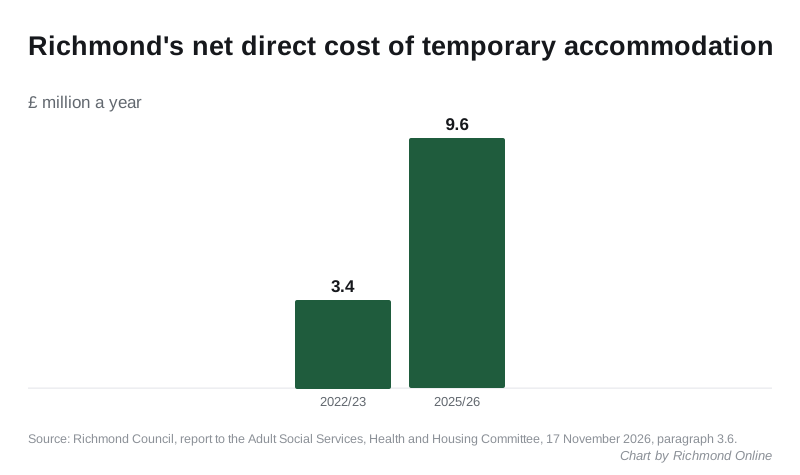
Richmond Council wants to lease homes for ten years and a day to house homeless families. Its net temporary accommodation cost rose from £3.4m to £9.6m in three years.
Richmond Council wants to lease homes from private landlords for at least ten years and a day, to house homeless families more cheaply than it does now.
The net direct cost of temporary accommodation has nearly tripled, from £3.4m in 2022/23 to £9.6m in 2025/26. That is in a report to the Adult Social Services, Health and Housing Committee, which meets on Tuesday 17 November.
The council’s latest budget forecast for the same meeting shows the housing department heading for a £2.698m overspend this year. At the end of the first quarter it expected to come in £49,000 under budget.
Why the council wants to change
Most of Richmond’s temporary accommodation is rented night by night from private providers. The report lists the problems with that:
- providers can raise prices with little warning
- quality varies, and the council has little control over standards
- high costs make it hard to move families on into private rented homes at Local Housing Allowance rates
- more households come in than move out, so the caseload keeps growing
There is also a subsidy problem. Housing benefit for families in this kind of accommodation is capped at 90% of the 2011 Local Housing Allowance rate, which the finance director notes has been frozen for more than 15 years. On a lease of ten years or more, the council says it can charge the current Local Housing Allowance rate instead.
The council’s finance director estimates a “potential net benefit of £6,000” a year for each home secured this way.
How the leases would work
The council would in effect become the tenant of each home and place a homeless household in it. The leases would last a minimum of ten years and one day, which is where the scheme’s “ten plus one” name comes from.
The report says homes could be inside or outside the borough. Each one would be checked by an internal board of housing, legal, finance, benefits and procurement officers before the executive director of housing signs it off. Larger deals would come back to a committee.
Over five years, the council aims for roughly:
- a third of its temporary accommodation on long leases
- a third owned by the council
- a third under other arrangements, to keep some flexibility
How many families are in temporary accommodation
The budget forecast says 817 households were in temporary accommodation in August 2026, or 721 not counting “homeless at home” cases. The council’s forecast assumes those numbers fall to 716 and 637.
It gives the average annual net cost of a household in temporary accommodation as £16,860. Prevention work has stopped 67 households needing it so far this year, avoiding £1.13m in costs, the forecast says.
The forecast also says the number of households entering and leaving temporary accommodation “has largely levelled in the last three months”. But it warns that the savings from leasing will not show in the budget until next year.
What it means for you
If you are homeless or at risk of it, the council’s housing options team is still the first contact. A family placed under this scheme could have a longer, more settled stay in a better-quality home, but it might be outside Richmond.
For council taxpayers, temporary accommodation is now one of the largest pressures on the council’s budget. The council has also been changing how it allocates social housing.
The committee meets at 7pm on 17 November in the Salon at York House, Twickenham, and the papers are online. The same meeting will consider a new contract for the borough’s health visiting and school nursing service.
Have your say